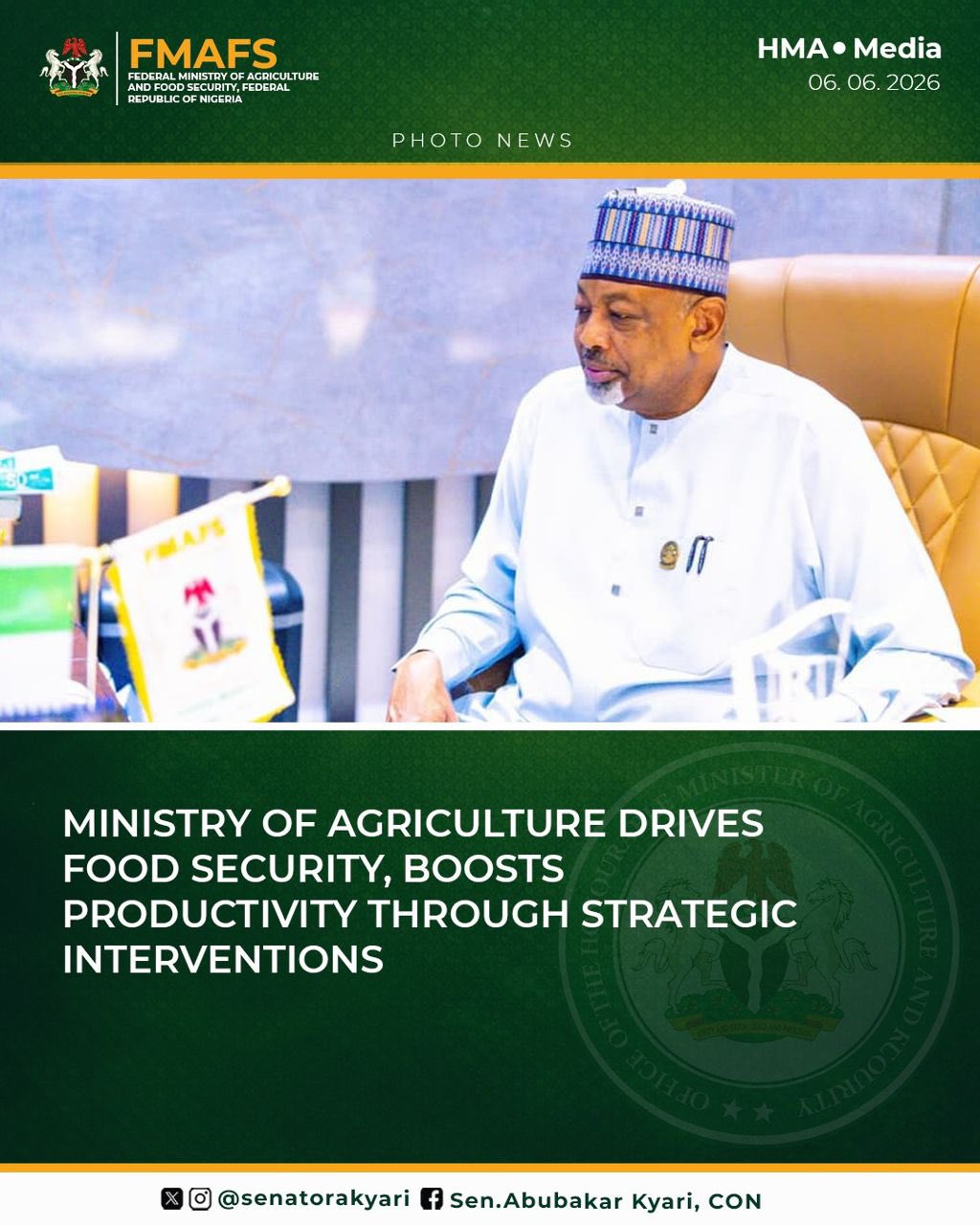
The Federal Ministry of Agriculture and Food Security has recorded notable progress in advancing food security and agricultural productivity under the Renewed Hope Agenda of President Bola Ahmed Tinubu, GCFR.
Speaking at a Stakeholders’ Engagement Forum on Agricultural and Food Systems Transformation, the Minister of Agriculture and Food Security, Senator Abubakar Kyari, @SenatorAKyari CON, highlighted key achievements of the Ministry, including:
• Reduction of food prices for major staples by up to 50% nationwide.
• Strategic interventions across key agricultural value chains, including rice, maize, wheat, millet, sorghum, cassava, cocoa, soybeans, cotton, and oil palm.
• Distribution of over 1.9 million bags of fertilizer to nearly one million farmers.
• Provision of improved seeds, agrochemicals, safety kits, and pest management support to farmers.
• Increased crop production as confirmed by the 2025 NAERLS Agricultural Performance Survey.
• Establishment of a National Reference Laboratory and upgrade of the National Fertilizer Management Platform to enhance fertilizer quality control and curb adulteration.
• Training of more than 3,500 farmers on sustainable soil management practices.
• Construction of approximately 170 kilometres of asphalt roads and 57 kilometres of earth roads in rural communities.
• Installation of 296 motorized and solar-powered boreholes, 3,596 solar street lights, and 69 rural housing and market facilities.
• Deployment of 2,000 tractors and assorted agricultural equipment under the Renewed Hope Agricultural Mechanization Programme.
• Establishment of 10 large-scale integrated processing plants and seven composite flour milling factories.
• Creation of Agribusiness Incubation Centres at Federal University Lokoja and Michael Okpara University of Agriculture, Umudike.
• Profiling of 7,398 farmers and promotion of climate-smart agriculture under the Special Agro-Industrial Processing Zones (SAPZ) programme.
• Registration of over 647,500 farmers and support to 622,818 beneficiaries with subsidized inputs under NAGS-AP.
• Yield increases of up to 20% through the Nigerian Farmers Soil Health Scheme.
• Provision of ?700 billion agricultural insurance cover to 199,275 farmers through the Nigerian Agricultural Insurance Corporation.
• Approval of a ?250 billion facility for the Bank of Agriculture to provide affordable financing to farmers.
• Strengthening of cooperative societies through the registration of 40 National Cooperative Apexes and capacity-building programmes.
• Expansion of opportunities for women and youth through access to finance, extension services, and climate-smart agriculture training.
• Adoption of the First Lady’s “Every Home a Garden” initiative to encourage household food production and improve nutrition.
Senator Abubakar Kyari, CON, reaffirmed the Ministry’s commitment to sustaining these gains through innovation, strategic partnerships, and increased investment in the agricultural sector to achieve lasting food security and economic growth.
You May Also Like