
 Rasheeda Yahaya
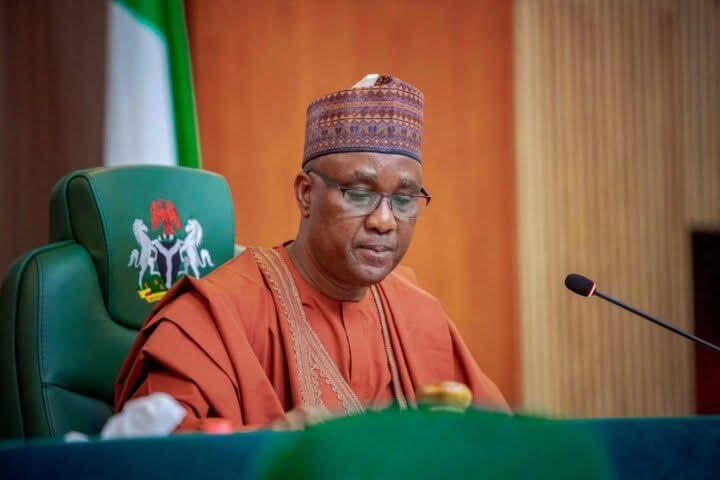
The Speaker of the House of Representatives Rt. Hon. Abbas Tajudeen, Ph.D., GCON, has urged the All Progressives Congress (APC) to create models and strategies on how to manage its new and old members and codify the achievements of the ruling party.
He, therefore, proposed three things the APC must do to remain a united ruling party.
Speaker Abbas gave the advice at the National Executive Committee (NEC) meeting of the APC at the Presidential Villa Abuja on Friday night.
He said, “Distinguished colleagues, allow me to turn directly to the question of party unity. At our caucus meeting yesterday, I made a point that bears repeating at this NEC. Today, the All Progressives Congress is not the same party it was in 2015 or even in 2019. We are a governing coalition that continues to grow. We have founding members who built the party through sacrifice. We also have new members who have joined us because they see the APC as the vehicle of national stability and progress.
“Managing this balance between old and new members is now a strategic imperative. If not handled with sensitivity, fairness, and institutional discipline, it can lead to fragmentation. Fragmentation is a luxury the Party cannot afford as we look towards 2027.”
“Cohesion does not mean uniformity. It means inclusion, respect for contribution, and clear rules that bind everyone equally. NEC has a critical role in ensuring that integration is deliberate, grievances are addressed early, and party structures remain authoritative.”
From comparative experience in advanced democracies, the Speaker noted that parties lose power not primarily because of opposition strength, but because of internal disorganisation and unresolved factionalism. “Unity, therefore, is not a slogan. It is a system,” he stated.
Speaker Abbas said, “This is why I respectfully propose three practical steps for our party.”
The first, the Speaker said, is to institutionalise a simple APC Governance Delivery Dashboard: a quarterly snapshot that tracks cost of living indicators, security outcomes, job creation initiatives, and key social interventions.
“Not for propaganda. For internal discipline. Parties that govern well measure themselves honestly before the public does it for them,” he stated.
The second, Speaker Abbas said, is to formalise a Legislative Executive Programme Grid: a clear mapping between our manifesto commitments, the bills before the National Assembly, and the budget lines that fund them.
“This ensures coherence. It prevents policy drift. It allows our candidates and officials to speak with one voice across all levels of government,” he said.
He proposed a third, which is to strengthen internal democracy without weakening governing capacity. “Disagreements are inevitable in a large coalition like ours. What matters is process. Clear rules. Timely dispute resolution. Respect for party organs. In mature democracies, parties lose not because they disagree, but because they allow disagreements to become public disorder,” he said.
The Speaker posited that candidate quality also deserves urgent attention. “Weak candidates do not merely lose elections. They undermine governance and erode party credibility. Training, ethical standards, and basic policy literacy should be seen as national assets, not optional extras,” he said.
Speaker Abbas added, “As we prepare for the next phase of governance and electoral competition, let us remember that Nigerians are watching less what we say and more what we deliver. The All Progressives Congress must remain a party that wins power and earns trust. A party that governs with discipline. A party that sees institutions not as obstacles, but as instruments of national renewal.”
Speaker Abbas told the APC NEC that the House appreciates President Bola Ahmed Tinubu GCFR. He said in a period of profound economic adjustment and inherited structural constraints, the President has “demonstrated resolve, clarity of purpose, and confidence in democratic institutions.”
He added that the reforms “have been difficult but necessary, with the legislature working to stabilise them through law, oversight, and representation.”
The Speaker noted, “In mature democracies, reform relies on legislative partnership, which this administration has deliberately fostered.”