
 Rasheeda Yahaya
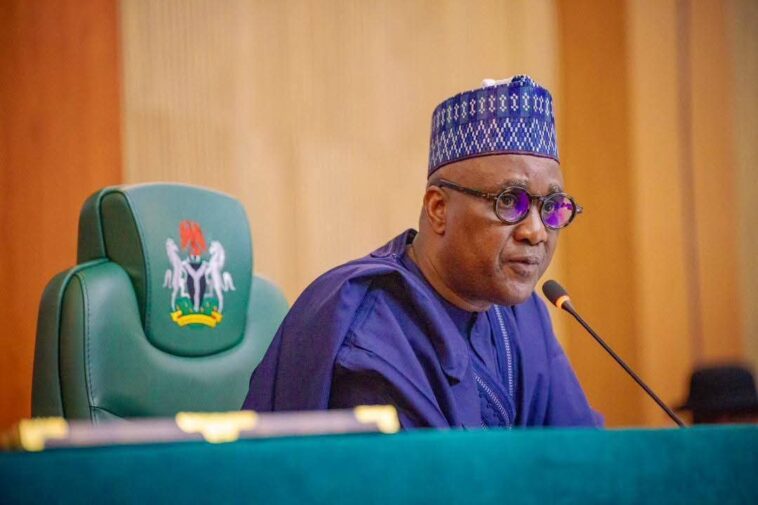
The Speaker of the House of Representatives Rt. Hon. Abbas Tajudeen, Ph.D, GCON, has advanced legislative efforts aimed at repealing and re-enacting laws governing the efficient and effective generation and administration of statistical data in Nigeria.
The Speaker’s proposed legislation entitled
‘A Bill for an Act to Repeal the Statistics Act, No. 9 of 2007, and Enact the Statistics Bill, 2025, to Enhance the Responsiveness, Relevance, and Effectiveness of the National Statistical System in the Digital Era, Establish an Improved Funding Mechanism, and for Related Matters (HB.2491)’ passed through second reading on the floor of the House on Tuesday.
Co-sponsored by Hon. Adegboyega Nasiru Isiaka, the bill seeks to introduce a modern and robust framework that empowers Nigeria’s statistical system to deliver on its mandate more efficiently.
Leading the debate on the general principles of the bill, the co-sponsor, Hon. Isiaka, described the bill as a “very important bill,” saying that “data has become the currency of sustainable development in the modern world.”
“From policy formulation to economic planning, social investment, national security, and global competitiveness, every forward-looking nation today anchors its decisions on accurate, timely, and reliable statistical evidence. Nigeria cannot afford to operate with an outdated legal framework that no longer supports the dynamic and digital data environment in which the world now functions. The Statistics Act of 2007, though useful at the time, has been overtaken by technological advancement and the new realities of the 21st-century statistical ecosystem.
The co-sponsor further highlighted the objectives of the proposed Act,saying that “This bill aims to achieve the following:i. Strengthen coordination of data/statistics across all levels of government:
ii. Enhance the autonomy and professional independence of the National Bureau of Statistics.
iii. Establish a sustainable funding mechanism that guarantees the timely production and dissemination of official statistics.
He argued that in the absence of credible data, public policy becomes guesswork and national planning risks being disconnected from reality.
“This Bill will ensure improved data integrity, quality assurance, and comparability in line with international standards. It mandates the establishment of statistical units in all Ministries, Departments and Agencies, staffed with competent professionals from the Bureau, while also creating stronger collaboration between the Federal Government, the States and Local Governments to eliminate duplication, wastage and inconsistencies in data production.
“It also promotes open access to data so that policymakers, researchers, private sector organisations and the public can benefit from an efficient national data system.
“If passed, the Bill will significantly elevate Nigeria’s global statistical rating and strengthen the foundation for evidence-based budgeting, accountability, and national development planning. It will boost investor confidence, facilitate better monitoring of key programmes such as the National Development Plan, Sustainable Development Goals, and improve national competitiveness as decisions become grounded in facts rather than assumptions,” he said.
The Bill which is divided into eight parts, covers areas such as:
(1) Establishment, Objectives, and Functions of the National Statistical System;
(II) Establishment and Functions of the National Bureau of Statistics;
(III) Establishment and Composition of the Board;
(IV) Appointment of Statistician-General of the Federation and Other Staff of the Bureau;
(V) Establishment, Composition, and Functions of the National Consultative Committee on Statistics;
(VI) Power to Obtain Information, Confidentiality and Disclosure, and Offences and Penalties;
(vii) Funds and assets of the Bureau, as well as
(viii) Miscellaneous provisions.